
The DTS Fadeout, AI Fan Companions, and F1 Power Couples!!
WTF1H 01 | Weekly Digest where F1 Meets Business and Culture.



Hi there! Welcome to Track Limits, a weekly newsletter where F1 meets business and culture. For the curious, the fun-loving, and the slightly obsessed!!
Good Evening!! After one of the shortest off-season ever, we are back to business. Melbourne, once again, proved it’s a vibe of its own and the best place to kick off the season. But while off-track everything seemed great, on-track the story was one of collective confusion and harsh criticism!
Fans weren’t having it with the super clipping, overnight changes to the straight mode, and all the energy deployment strategy conversations. Drivers weren’t happy either, and all weekend long they made their concerns known to the media and the FIA. The only ones who looked like they were living their best lives were Mercedes. Not only did their smiles return, but their confidence is at an all-time high — with a pole position, a double podium finish, and a 15-second gap, who can blame them!!

If you thought the 2026 season was all about new cars and regulations, think again!! Never have I seen the winter break — and Formula One in general — produce this many brand announcements, fashion content, WAG drama, fan querells and just overall nonsense. It’s a great sign, but it does mean today will have to be a quick rundown!
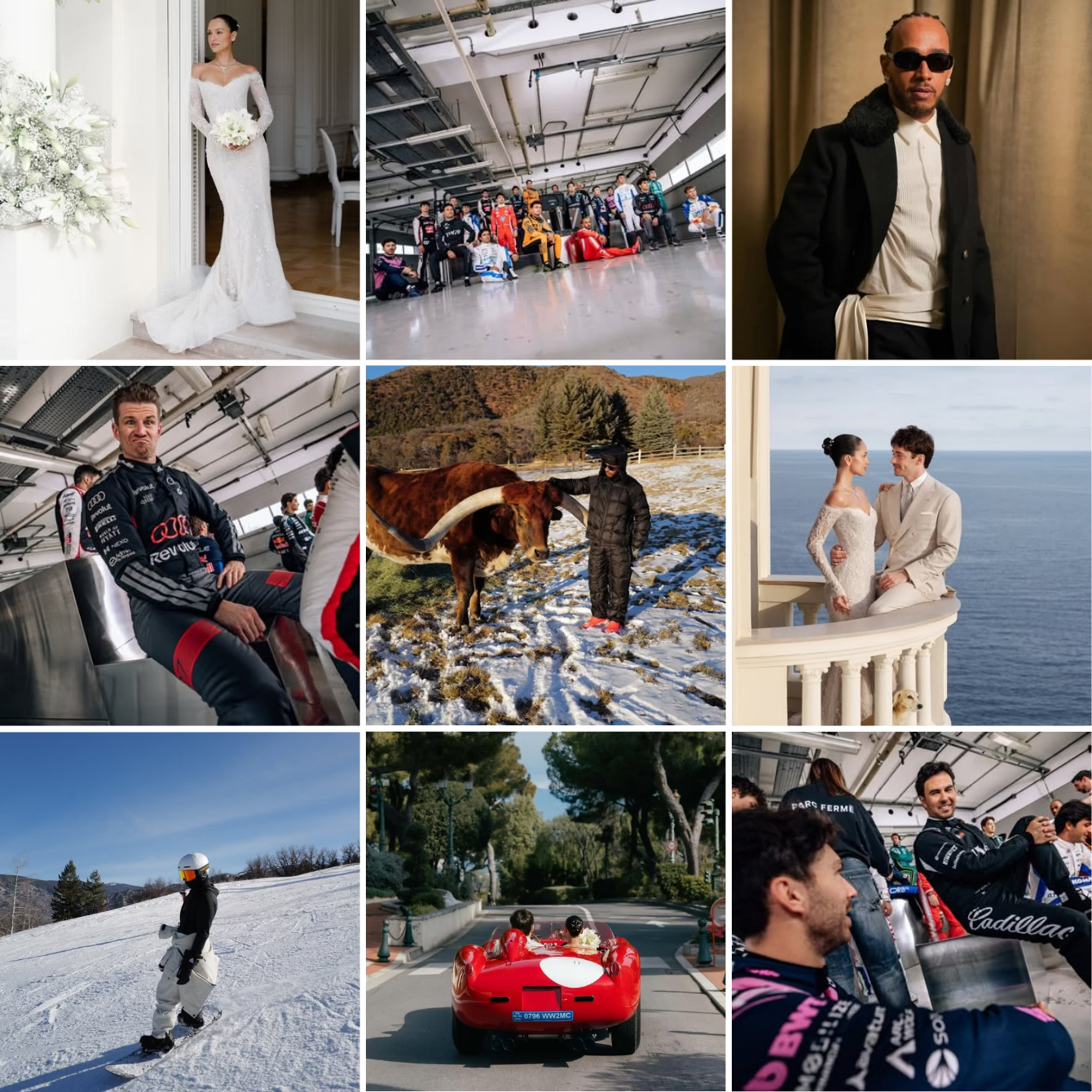
Power Couples. It’s probably not a surprise to anyone at this point that Leclerc married his long-time girlfriend and F1 It Girl Alexandra Saint Mleux a week before the Australian Grand Prix. Sure, the custom long-sleeved Paolo Sebastian gown with an off-the-shoulder neckline and beaded flowers and butterflies was beautiful, and the cinematic ride of the couple in a 1975 Ferrari 250 Testa Rossa was outrageously annoying!! All that was to be expected from a Leclerc wedding, even a civil ceremony one.
But it also marked a clear move into power couple territory. Not only did she change her name — which is raising a few eyebrows in any country that has a E.Leclerc grocery store. Why would you do that with such a pretty name?! — but the wedding content was anything but random — they gave us a whole “series” with multiple Instagram carousels and videos even tagging Lecerc’s creative studio! The intentions were anything but subtle, and it achieved exactly what it set out to do: make the Leclerc’s F1’s It Couple well beyond the grid.
This is not a bad thing per se. It’s a long-anticipated move, and one that appears to be driven by the women in the paddock themselves — recognising the cultural influence their WAG status affords them, and leveraging it into commercial opportunities.
And the Leclerc’s aren’t the only ones looking to converge their forces! Russell and Montero Mundt, while not legally coupled, have already merged their public personas and even gone into business together. This has included awkward Tommy Hilfiger and Ritz Carlton ads and a newly created holistic skin care brand called Barriers. Described as “microbiome-intelligent skincare made from edible ingredients grown in our farm”, which is very on brand for both of them!!
Even the younger drivers on the grid are getting in on it. Take, for example, Lawson’s partner, Hannah St. John — she is clearly trying to follow the Morgan Riddle playbook by filming her life while travelling the world with her high-performance athlete boyfriend and wearing outrageous, expensive diamond necklaces!! Yes, if you saw the viral videos and photos of the F1 calendar-inspired $350k dimand necklace and thought it was some random influencer. It wasn’t!! So despite the California native being pre-med, all indications suggest she is pursuing an influencer career instead.
These and several other drivers on the grid who are publicly positioning themselves as #couples suggest that they have figured out there's a real benefit to making the women in their lives central part of the weekly circus! And F1 isn’t far behind with WAGs becoming “mandatory content” each weekend!
All of this makes sense when you think about it — sports fanbases are becoming more evenly split by gender, more female-focused brands are making their way onto the grid or hovering on the sidelines — yes, Rhode, I’m talking about you! — and women's disposable income keeps growing every year.
Title Sequence Slop. I have to admit I’m kind of a sucker for theme songs and title sequences. Call me a TV-obsessed millennial, but name me a show that made it big with a crappy theme song or a horrible title sequence? Exactly!!!
Sure, they can’t all be iconic like Friends, Sex and the City, Game of Thrones, Only Murders in the Building or The Simpsons. But at least give me a vibe, a story or a cinematic experience to look forward to while we wait for the race to start. At this point, the theme song is doing all the heavy lifting — and there is really no need!
A quick YouTube search will give you the most outrageous F1 title sequences ever made, including those for BBC and Sky Sports. From Eagles popping up out of nowhere, casino roulettes spinning in the air, women with snakes, cars driving through deserts — Formula One has done it all!! Is it highly cringe? Absolutely! But from a sport with a premise as outrageous as 22 short rich guys driving highly sensitive cars at +300km/h around the world, that’s kind of what I want!!!
And this year it’s anything but. Not only that, but the “hero shoot” — done at the start of each season — is technically a beautiful shot, but creatively extremely meh. With so much creative talent in and around the paddock and with million-dollar budgets, it’s baffling that F1 official shoots, campaigns, and title sequences feel and look more and more like corporate slop.
At least HBO recognised the amazing editing talent of a Heathed Rivalry fangirl and actually hired her to create promotional edits. Formula One could use this idea and give fans an active role in co-creating the sport’s promotional output. Seriously, who better than a fangirl to convince anyone their hyperfixation is absolutely worth watching?!
Old School Shenanigans. Tales of driver shenanigans have been told for generations, but unfortunately, I have never witnessed them in real life! But it looks like Sir Lewis Hamilton is bringing it back!! Not only is he dating — or at least it looks like he is — one of the most polarizing pop culture figures of the last two decades, casually attending the Super Bowl, showing up at Paris Fashion Week, posting topless selfies at the gym, but he's also building a farm. Complete with one of the biggest and most beautiful cows I've ever seen. Her name is Max. No, he didn't name her himself, but he absolutely sees the humor in it — so much so that he made sure the whole world knew about it!!
How all these things co-exist, I honestly don't know. But it does give me hope that at least one driver on the grid hasn't forgotten the chaotic, fun-loving, slightly over-the-top, sometimes sassy off-track driver persona that for years has been part of the Formula One lore!!

A couple of stories to keep on your radar.
1. Salesforce Fan Companion Agent. Formula 1 announced the launch of a new AI-powered fan engagement and education agent to help fans better understand the new regulations. Hosted on the Formula 1 website, the agent will allow fans to ask it any questions on the 2026 regulations and provide clear, accessible and updated answers as well as valuable insights. This is especially relevant for younger and incoming fans.
What makes it interesting is that, in addition to expanding on how Formula 1 uses artificial intelligence, it will be an opportunity for the sport to collect data on recurring themes and questions fans have, as well as on the specific markets in which these fans are located. This undoubtedly will shape fan-facing promotional material and educational content across the F1 ecosystem.
2. Alpine’s Primark Collection. While another merch collection sounds anything but groundbreaking, Primark actually makes it so. The French team didn’t abandon their premium-priced regular merch — they expanded it by creating a lower-priced collection to reach a wider audience.
While the high-street giant could be seen as diluting the Alpine brand, it actually aligns with the team’s ongoing push to be the go-to team for young, digitally native Gen Zers — the GP Explorer was a critical partnership in doing so, especially in France. For this audience, Primark is already a familiar touchpoint; a €20 hoodie is an attractive proposition for the casual fan, and the fast-fashion giant has the added benefit of bringing visibility to Alpine beyond the F1 bubble. It will be interesting to see whether other teams will follow this strategy.
3. McLaren Golf. No, this is not the announcement of a limited edition papaya golf attire! McLaren launched a new venture — an actual separate company — dedicated to the manufacturing of golf equipment. On the surface, this jump into a totally new category might seem odd, but several things make it a potentially great move.
First, in 2028, the USGA and the R&A (the two primary governing bodies of golf in the world) are implementing new regulations — which makes the perfect moment to enter the market. Secondly, McLaren has decades-long engineering know-how in everything from carbon fiber composites, aerodynamics, and materials science that it can transfer to golf equipment — a low-risk, high-margin play into a growing global market. And finally, there is an overlap between F1 fans and golfers. Not just that, but the audience shift F1 experienced in the last five years is happening in golf at the moment. We are seeing more young, female, and diverse golfers than ever. Giving McLaren not just the technical credibility for old-school players, but the cultural cachet for incoming ones!

How Drive To Survive Failed to Keep Up
As the season build-up reached full swing, Netflix released the latest season of its acclaimed sports docuseries Drive to Survive. For eight years, the show has provided a unique entry point for new audiences — mainly young and female — drawn to its emotional and narrative-driven storytelling.
However, with each passing year, the excitement surrounding the 10-episode recap of the previous season has noticeably faded. Fans who once eagerly counted down the days until its release, dissected every second and frame, now seem less interested than ever. Whig begs the question: Is the show still relevant?
The Billion Dollar Spark
In 2017, when Liberty Media acquired the commercial rights to Formula 1, the sport’s media strategy was heavily reliant on television. Digital media was almost nonexistent, as the previous rights holder completely disregarded it, famously stating: “I’m not interested in tweeting, Facebook, or whatever this nonsense is. I tried to find out, but in any case, I’m too old-fashioned. I couldn’t see any value in it. And I don’t know what the so-called young generation of today really wants.” Even teams and drivers were being restricted from using social media during race weekends.
But with sponsorship interest being flat and global viewership declining, Liberty Media saw digital media as an opportunity to modernize race broadcasting and attract younger audiences, whose media consumption shifted toward digital channels.
As part of this strategy, Formula 1 finally allowed teams and drivers to capture race weekends and partnered up with Netflix for an exclusive behind-the-scenes series. For the first time ever, Formula 1’s impenetrable paddock, backdoor politics and fascinating insiders became accessible to all. Making the sport easier to understand, discoverable on a global scale, and flooding social media feeds with all kinds of content, including millions of pieces created by fans.
The result was an unexpected spark of interest that surged global viewership, record-breaking attendance and sponsorship interest, driving up both Formula 1’s market cap and revenue.
A New Media Reality
Today, Formula 1’s media strategy is even more diversified, spanning across digital media — social platforms, apps, podcasts, websites, video games and fantasy leagues — as well as traditional mass media, with projects like the Hollywood movie starring Brad Pitt that not just dominated the box office last summer but managed to receive four Oscar nominations. The sport has also strengthened its presence in print through partnership with Condé Nast — the owner of Vogue, GQ, The New Yorker, Vanity Fair and Architectural Digest — and the rise of independent magazines solely dedicated to Formula One.
Whether owned, earned, or paid, the sport’s media presence is broader and more diverse than ever.
However, this also means that Formula One and its main characters are no longer a mystery. Today, anyone with a social media account can get an inside look into drivers’ lives, catch a glimpse of a team’s race-weekend preparations, grab a live scoop from a journalist at the paddock, or hear insights straight from a team principal’s weekly debrief. While this level of access keeps fans engaged year-round, it inadvertently weakened Drive to Survive’s once unique value proposition: access.
The Season 8 Turning Point
Formula One Management seems to have recognized this shift in 2024 when an insider revealed that capturing behind-the-scenes content was being restricted — something reflected in the disappearance of fan-favorite team-produced shows like McLaren Unboxed, Aston Martin’s Insider, as well as the scaling down of others like Ferrari’s Full Access.
Though the show’s problems ran deeper than the overexposure of Formula One alone. It not only failed to evolve with its audience — who are no longer newcomers to the sport — but it also increasingly moved toward scripted moments and carefully curated storylines that drained it of the raw authenticity that made it compelling in the first place. Leaving fans with a show that feels both irrelevant and, frankly, boring.
This meant Drive to Survive found itself at a turning point, needing to prove to its original audience that it was still worth watching, and to Formula One and Netflix that its exclusive access continues to produce a worthwhile return. And season 8 couldn’t be more fitting for this reset. The sport was preparing for its biggest regulation change ever, a new team was going to step onto the grid for the first time in a decade, and a fresh group of rookies was hungry to make their mark.
Yet Drive to Survive decided not to take the opportunity to once again fuel fans’ curiosity with unique storylines, important but uncomfortable conversations, new character studies, and truly never-before-seen moments. Which explains why a quick glance at trending topics on major social media platforms in the weeks following its release, along with search queries related to the sport and series, paints a picture of fading relevance — one Netflix has yet to counter with viewership data.
All of this suggests that Drive to Survive has entered a phase of diminishing returns and no longer holds the same weight as a driver of growth for the sport.
A New Role
This, however, doesn’t mean Drive to Survive will disappear overnight.
While its influence was never meant to last forever, the show still holds value. Even after its final season — rumored to have been this one — it will likely continue to serve a purpose for both Formula 1 and Netflix.
As part of the streaming platform’s content library, it becomes a source of “passive income” — requiring no further investment from either party while still drawing in new audiences to discover it. Netflix could even license the show to other streaming platforms — something the recent collaboration between Apple, the new U.S. broadcaster, might be hinting at as a way to allow Formula One’s presence to be centralized on one platform — creating an additional revenue stream and expanding F1’s reach even further.
So while the show’s cultural impact has disappeared, its mark on both Formula One’s global expansion and Netflix’s position in sports media is undeniable. It redefined how sports use storytelling to attract new audiences, reshaped fan engagement, played a key role in modernizing Formula 1’s media presence, and ultimately unlocked a new era of commercial and cultural growth for the sport. And long after its final episode airs, Drive to Survive will more than likely continue to bring fresh eyes to the grid — much like other “classic” series find new life on streaming platforms every year.

This week’s content worth your time!!
🗞 READ
Apple’s New F1 OS | What LVMH is Really Buying in Formula 1 | F1’s Real Customers aren’t Watching on Sunday | Fashion didn’t invent the gallerina — it simply caught up to her | Is F1 Entering Its Super Couple Era?
🎧 LISTEN
Team Torque: Cartoon Characters, Ted Lasso & Vegemite vs Marmite | Acquired: The History and Business of Formula 1 | BTS from the Australian Grand Prix SkySport TV Gallery | S**t Questions Albert Park Edition
Photo Credit: The paddock Club, Charles Leclerc, Formula 1, Lewis Hamilton